
Mobile security isn’t just evolving, it’s being forced to change. Based on Approov’s expanding customer base, live threat telemetry, and ongoing research, we’re seeing clear signals that long‑standing mobile security assumptions will fail in 2026.
Some of these trends started emerging in 2025, but 2026 will be the inflection point where they go mainstream, and old defenses break under pressure.
If you’re responsible for mobile app or API security, these are the disruptions you should be planning for, as we enter 2026.
1. AI-Powered Reverse Engineering Makes Obfuscation Obsolete
The trend:
For years, mobile app security relied heavily on code obfuscation as a first line of defense. That era is ending. That's why traditional obfuscation vendors are struggling and consolidating and mobile code obfuscation vendors like Appdome, Zimperium and Promon are desperately trying to pivot toward runtime verification and API-level defenses before the obfuscation market disappears completely.
In 2026, AI-assisted tooling will make traditional obfuscation increasingly ineffective. GPT-assisted Frida scripts, AI-driven decompilers, and vision-based dynamic analysis tools can already identify sensitive logic paths, extract API schemas, and reconstruct workflows, even in heavily obfuscated apps.
Accessing obfuscated code was always possible, but it took skill and time. What's happening now is that what once required elite reverse engineers will increasingly be automated and repeatable using AI.
What this looks like in practice in 2026:
- Secrets and API endpoints will be discovered hours after release
- Business logic will be mapped without static code analysis
- Automated tooling will adapt to each app update
How to prepare:
If you are deploying mobile apps, you must move away from “hiding code” as a primary control. Instead, it's time to focus on runtime integrity validation, device trust, and just‑in‑time delivery of secrets and tokens that cannot be harvested offline.
2. The API Becomes the Primary Attack Surface in Mobile
The trend:
In 2026 attackers aren’t going to aim to “hack your app”, the real prize is abusing the APIs your app depends on.
As mobile OS protections improve and app binaries become harder to tamper with directly, attackers are shifting their focus upstream to backend APIs. This includes credential stuffing, token replay, session spoofing, and business logic abuse — often using legitimate app builds on clean devices. We’re already seeing this shift accelerate. Just one example is the Thales 2025 API Threat Landscape Report which reports a massive spike in API-Based attacks as APIs have become a preferred target for cybercriminals as they fully automate attacks.
This is particularly dangerous because most APIs still trust the client too much. If a request has a valid token, it’s often accepted, regardless of how it was generated or replayed.
How to prepare:
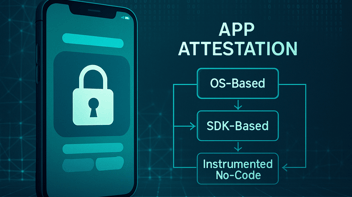
Anything that tries to access an API must be considered suspect until proven otherwise. Implement per-request validation that proves the request originates from a verified app instance running in an uncompromised environment — not just a copied token. We predict that in 2026, app attestation, which ensures only genuine, uncompromised apps can communicate with APIs, will become a standard practice, especially in high-stakes industries like finance and healthcare.
3. Bots Will Look Exactly Like Your Mobile App
In 2026, the biggest API threats will come from bots and scripts that look exactly like real users, tuned with LLMs to evade detection and abuse mobile-specific APIs.
In 2026, bots will increasingly:
- Run on real devices or rooted emulators
- Mimic app telemetry and sensor data
- Use LLMs to generate context-aware API requests
- Replicate human interaction patterns
Traditional bot defenses — IP reputation, rate limiting, WAF rules — will struggle to distinguish these impersonators from real users.
What this enables:
- Large-scale scraping from “legitimate” mobile flows
- Inventory draining and promo abuse
- Credential testing that bypasses web-centric defenses
How to prepare:
You need a way to cryptographically distinguish real apps from impostors — even when the traffic looks perfect. That means tying API access to runtime-verified app identity, not surface-level signals.
4. Mobile Security Gets Dragged into AI Compliance
As AI-powered mobile apps proliferate, and new AI related mobile threats emerge, regulators and enterprises will increasingly scrutinize how those apps access and protect data.
It won’t be enough to say “we use TLS” or “we authenticate users.” Enterprises integrating AI-driven mobile apps will demand proof that:
- APIs are only accessed by genuine apps
- Devices are not compromised
- Sensitive data paths are protected end-to-end
This is especially true in regulated industries like healthcare, finance, and government.
How to prepare:
Apps must be ready to provide cryptographic proof of runtime integrity — not just policies or documentation. Mobile app security will increasingly be part of AI trust, risk, and compliance conversations.
5. App Stores Lose Control — and Security Gets Decentralized
Regulatory pressure (EU DMA, UK reforms) will continue to weaken the app store monopoly model. Alternative app stores, sideloading, and direct-to-consumer distribution are expanding — especially outside the USA.
App store security controls were never sufficient, but they at least provided a centralized checkpoint. As that checkpoint erodes, security responsibility shifts decisively to developers and enterprises.
A number of other trends are driving the decentralization of security:
- HarmonyOS and non-GMS Android gaining traction
- Embedded platforms (automotive, wearables) expanding
- Platform-native attestation is ineffective
- Developers seek the cost-savings and convenience of cross-platform development
How to prepare:
Dev teams must adopt cross-platform, app-store-independent security controls that work across iOS, Android, HarmonyOS, and beyond — without assuming Play Integrity or App Attest will always be present or correctly enforced.
6. Security Must Be Updateable — Without Rebuilding the App
Threats evolve faster than app release cycles.
In 2026, security teams will increasingly reject solutions that require:
- App rebuilds to change policies or rotate API keys
- Hardcoded secrets in app code
- Static detection logic
This is already a major source of friction between security, devops and mobile teams.
What teams will demand instead:
- Server-controlled policies
- On-the-fly response tuning
- Rapid mitigation without redeployments
- Over-the-air updates to security solutions
How to prepare:
Teams must choose security architectures where enforcement logic lives outside the app, allowing you to respond to threats in real time — not weeks later via app store updates.
7. Zero Trust Finally Comes for Mobile Apps
Zero Trust has reshaped networks and identity — but mobile apps have largely been left out.
That’s about to change.
In 2026, enterprises will increasingly require proof that:
- Every API request comes from a legitimate app
- That app is in a known-good runtime state
- Trust is continuously re-evaluated, not assumed
The danger is that the phrase “trust the client” will be tied to breach reports in 2026.
How to prepare:
Extend Zero Trust principles to the mobile layer. Every request should prove who the app is, what state it’s in, and why it should be trusted — continuously. This article by TAG Cyber explains how to do this.
Conclusion
Most 2026 prediction blogs focus on emerging threats. But the real disruption isn’t what’s new — it’s what’s no longer true. Silent failures of long‑held assumptions are what will catch teams off guard. And AI is the agent that will blow these assumptions away in 2026.
If your mobile security model still assumes:
- Obfuscation will keep attackers out
- A valid OAuth token means a trusted request
- Apps can’t be convincingly impersonated
- Google and Apple will take care of security for you
…then 2026 will be uncomfortable.
Take that second point above: a valid OAuth token proves that someone authenticated — but it does not prove that the request came from your real app, or from a secure, uncompromised device. Tokens can be extracted, replayed, or injected into traffic from bots, scripts, or cloned apps running on emulators or jailbroken phones.
That’s why Approov strengthens — rather than replaces — your existing authentication. Our attestation-based tokens are only issued when the app proves its authenticity and runtime integrity, ensuring that even if a token is valid, the app using it can be trusted.
The cracks in traditional mobile security assumptions aren’t hypothetical. They’re already visible in real-world attacks, threat telemetry, and vendor pivots.
But the good news is they’re not unmanageable. There is a way forward: if you evolve your assumptions and adopt a mobile security model that verifies each and every request to your APIs, you will be in good shape to face the future.
Approov specializes in securing mobile apps and the APIs they rely on — across all platforms and attack surfaces. If you’re rethinking your 2026 strategy, let’s talk.

George McGregor
VP Marketing, Approov
George is based in the Bay Area and has an extensive background in cyber-security, cloud services and communications software. Before joining Approov he held leadership positions in Imperva, Citrix, Juniper Networks and HP.