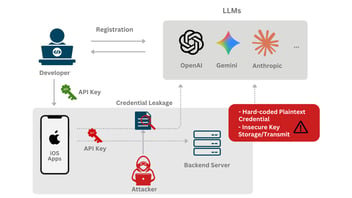

Mobile applications are no longer just software running on a phone—they are the primary interface to your core business logic and sensitive back-end data. Yet, because app binaries, local code execution, and API calls reside directly on the end user's device, your entire threat surface is effectively handed to potential attackers.
With the sudden rise of agentic AI-driven hacking tools, traditional mobile security approaches are officially failing. To protect modern infrastructure, CISOs and security teams must abandon temporary client-side fixes and move toward a zero-trust, architectural security posture.
The AI Threat to Traditional App Hygiene
In the past, reverse-engineering a compiled application required deep expertise and weeks of painstaking manual analysis. Today, attackers leverage automated, agentic AI capabilities to decompile mobile binaries in seconds, map back-end endpoints, extract embedded API keys, and launch sophisticated automated replay attacks at scale.
Relying on code obfuscation, basic behavioral monitoring, or hidden credentials only creates a false sense of security. Because attackers can now inspect both the static binary and runtime behavior effortlessly, any secret stored within an application—no matter how deeply hidden—must be treated as already compromised.
Shift Your Security Boundary to the API
Since client-side device environments can never be fully trusted, the primary security boundary must shift entirely to the back-end API. Protecting this ecosystem requires an architectural rethink grounded in a few non-negotiable principles:
- Eliminate Persistent Secrets: Storing long-lived passwords, static API keys, or embedded tokens guarantees eventual breach.
- App and Device Attestation: Continuously verify that incoming API calls originate solely from genuine, untampered mobile applications running on safe devices.
- Short-Lived, Instance-Bound Tokens: Utilize dynamically issued access tokens (such as instance-bound JWTs) valid for only a few seconds, rendering stolen tokens completely useless.
- Dynamic Certificate Pinning: Secure data in transit without the risk of application downtime when server certificates are updated.
Move from Authorization-Centric to No-Secrets Centric Security
Instead of playing a perpetual cat-and-mouse game trying to conceal code from AI-assisted decompilers, modern organizations need an architecture where there is simply nothing left of value to steal.
Approov’s Zero Secrets Architecture (ZSA) reimagines zero-trust for the AI era. By delivering short-term secrets at the point of use and enforcing real-time app attestation, ZSA ensures your systems remain completely secure even when attackers have total visibility into your application's internal mechanics.
Ready to rethink your mobile security strategy before attackers reverse-engineer your app?
👉 Download the Intellyx White Paper: Why Architectural Security is the Key to Mobile App Hygiene to discover how to protect your APIs and eliminate long-lived mobile secrets for good.

Mark Mazur
Field CTO of Approov
Mark Mazur is an accomplished Chief Technology Officer and Field CTO with over 20 years of experience architecting and scaling enterprise, mobile, web, AI, and server software. He has a proven track record of driving technology strategy for high-growth startups and mature organizations across cybersecurity, fintech, ad-tech, messaging, and gaming. Currently serving as the Field CTO at Approov Mobile Security, Mark specializes in mobile app security, API abuse prevention, and zero-trust bot protection. Previously, as CTO at Grow Credit Inc., he led a globally distributed, rapid Agile engineering team of 20+ engineers to deploy a containerized microservice platform and multiple partner integrations serving over 100K active users. Over his distinguished career, he has built robust MVPs, optimized infrastructure, and partnered with CEOs to create massive investor value for companies including TextPlus, Mobilityware, November Media, and NorthBay Solutions.