
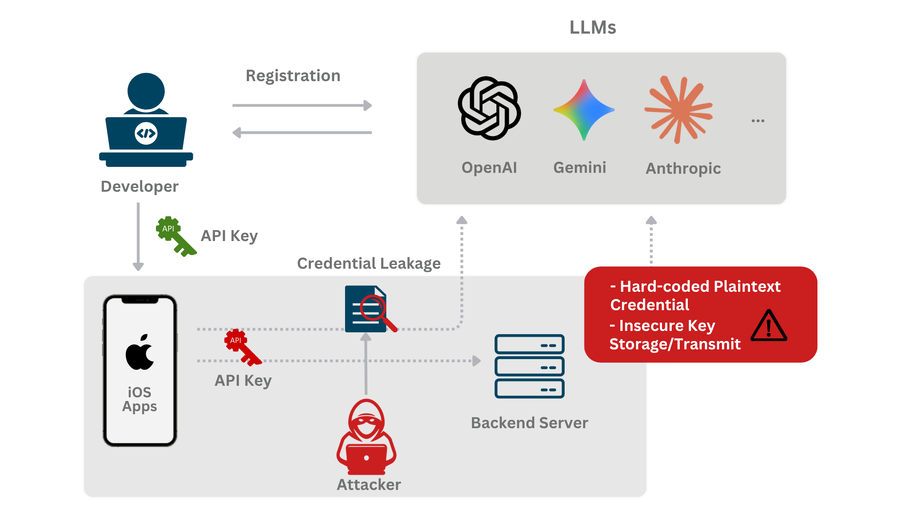
Mobile app developers are packing AI features into everything from writing assistants to productivity tools and lifestyle apps. New research shows that securing access to those services remains a challenge.
According to Mind your key: An Empirical Study of LLM API Credential Leakage in iOS Apps, a systematic analysis published by researchers at Wake Forest University, this rapid innovation is leaving a massive trail of exposed credentials in its wake.
The researchers analyzed hundreds of LLM-integrated iOS applications and discovered a systemic security gap between real-world developer practices and secure integration principles. Let's dive into the study's empirical findings and explore why transitioning to a "Zero Secrets" architecture using Approov.io is the only bulletproof way to mitigate these risks.
The Wake Forest Study: A Wake-Up Call for iOS Developers
The research team evaluated 444 iOS applications with confirmed LLM functionality. The results were staggering: 64% (282 apps) exposed exploitable LLM API credentials in network traffic, spanning at least ten different LLM providers and five cloud platforms.
This wasn’t limited to obscure apps built by amateur developers. Fully 15% of the vulnerable apps had over 1,000 user ratings, with the most popular affected app boasting over 2.3 million ratings. The vulnerability affects apps across 13 categories, with Health & Fitness exhibiting the highest leakage rate (47%).
The researchers identified three distinct leakage patterns among the vulnerable applications:
- 48% of the apps leaked JWT-based tokens.
- 33% of the apps allowed unauthenticated backend proxy access.
- 19% of the apps exposed plaintext API keys (with 47% of these affected apps simultaneously leaking proprietary system prompts).
When API keys and authentication tokens are leaked, threat actors can easily hijack your costly LLM accounts to launch unauthorized inference requests (shifting the financial burden to you), steal your intellectual property, or access sensitive backend data.
The "Proxy" Fallacy
A common misconception in mobile security is that placing a backend server or proxy between your mobile app and the LLM provider solves the API key problem. The study proved this false.
The researchers explicitly noted that "even those who adopt backend proxy architectures often fail to implement proper authentication and authorization mechanisms." If the mobile app relies on static tokens or flawed authentication protocols to talk to that proxy, attackers will simply extract those credentials and abuse the service.
Even after responsible disclosure by the researchers, the remediation rate remained critically low. Upon re-analyzing the apps three months later, they found that only 28% of the applications had successfully remediated the vulnerability, while 72% remained exploitable due to absent remediation actions or fundamentally flawed authentication implementations.
The Solution: Approov.io and "Zero Secrets" Architecture
The core of the problem is that developers are attempting to hide secrets in hostile territory. If an app contains an API key, an authentication token, or hardcoded cryptographic secrets directly in the client-side app code, a determined attacker—armed with traffic interception frameworks—will find it.
The only way to win this game is not to play. This is where Approov's Zero Secrets Architecture comes in.
Under a Zero Secrets model, your mobile application holds absolutely no long-lived credentials that can be stolen or reused. RASP and Attestation are used to ensure that the device OS and the application itself, are untampered and can be trusted. Additionally, by using certificate pinning you ensure the security and privacy of your network communications, preventing Man-in-the-Middle (MitM) actors from probing or scanning your network traffic. Typical pinning adds risky configuration updates and emergency deployments. Approov’s Dynamic Certificate Pinning is fully managed and prevents unsecure certificates from being inserted into the chain of trust. Secrets are handled securely in memory and by header substitution as they are deployed on the device.
Here is how Approov mitigates the systemic risks highlighted by the Wake Forest study:
- No Hardcoded API Keys: Approov ensures that your valuable LLM API keys and backend tokens are never stored in the mobile app. Instead, they are securely managed in the cloud.
- Deterministic Runtime Attestation: When your app makes a request to your backend proxy or LLM provider, Approov demands cryptographic proof of legitimacy. It verifies that the API call is coming from your genuine, unmodified application.
- Deep Environment Verification: Approov checks the runtime environment to ensure the host device hasn't been rooted, jailbroken, or compromised by the dynamic instrumentation frameworks commonly used to intercept network traffic.
- Just-in-Time Secret Delivery: Only after the device and app pass these rigorous integrity checks are short-lived tokens or secrets delivered "just-in-time" to authorize the API request.
- Dynamic Certificate Pinning: Ensures a secure, private channel between the application and the API endpoint by "pinning" the connection using the trusted root certificate, allowing fully automated management.
Ensure Secure AI Enablement with a Zero Secrets Approach
The Wake Forest University study makes one thing abundantly clear: traditional mobile authentication methods are failing in the AI era. Relying on obfuscation or simple, unauthenticated proxy servers is no longer enough to protect your expensive LLM API usage or proprietary system prompts.
By adopting a Zero Secrets architecture with Approov, you can ensure secure AI enablement in your mobile apps. Stop risking exposed credentials, and start cryptographically guaranteeing that only genuine apps on secure devices can access your backend infrastructure.

Mark Mazur
Field CTO of Approov
Mark Mazur is an accomplished Chief Technology Officer and Field CTO with over 20 years of experience architecting and scaling enterprise, mobile, web, AI, and server software. He has a proven track record of driving technology strategy for high-growth startups and mature organizations across cybersecurity, fintech, ad-tech, messaging, and gaming. Currently serving as the Field CTO at Approov Mobile Security, Mark specializes in mobile app security, API abuse prevention, and zero-trust bot protection. Previously, as CTO at Grow Credit Inc., he led a globally distributed, rapid Agile engineering team of 20+ engineers to deploy a containerized microservice platform and multiple partner integrations serving over 100K active users. Over his distinguished career, he has built robust MVPs, optimized infrastructure, and partnered with CEOs to create massive investor value for companies including TextPlus, Mobilityware, November Media, and NorthBay Solutions.