
Why API Keys, Certificates, and Credentials Don't Belong in Your App
Mobile apps have become the front door to nearly every digital service—from banking and healthcare to gaming and e-commerce.
But many organizations still make a critical security mistake: They store secrets directly inside their mobile apps.
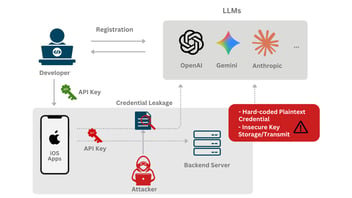
API keys, certificates, authentication tokens, and encryption keys are often embedded in the application and distributed to every user's device. Once the app is downloaded, those secrets are no longer under your control. As attackers become more sophisticated—and AI-powered tools make reverse engineering easier than ever—the risks of embedded secrets continue to grow.
The Problem with Mobile Apps
Unlike servers, mobile apps run on devices you don't own or control. Attackers can download a public app and use static or dynamic analysis to look for embedded secrets:
- Reverse engineer the application
- Analyze app traffic
- Inspect app memory during runtime
- Extract credentials and API keys
The reality is simple: A sufficiently motivated attacker can often recover secrets stored in a mobile app. The question isn't whether an attacker can access the application. The question is what they can access once they do.
Many organizations are surprised by how many secrets are embedded in their apps, including:
- API keys for backend services
- Third-party service credentials
- Authentication tokens
- Certificates or keys used in client/server trust decisions,
- Encryption keys
These secrets often provide direct access to APIs, cloud services, payment systems, and other critical business functions.
Why It Matters
When attackers extract secrets from an app, they can often bypass the app entirely and interact directly with backend services. This can lead to:
-
API Abuse: Attackers use stolen credentials to access APIs without using the legitimate application.
-
Fraud: Compromised credentials can be used to create fake accounts, abuse promotions, or automate malicious activity.
-
Higher Costs: Unauthorized API traffic increases infrastructure costs and can impact service performance.
-
Compliance Risks: Exposed credentials can create security and compliance concerns, particularly in regulated industries.
Why Traditional Approaches Aren't Enough
Many organizations try to protect secrets through:
- Code obfuscation
- Encryption
- Secret rotation
- App hardening
These measures can make extraction more difficult, but they don't solve the underlying problem. If a secret is embedded client-side, it remains exposed to reverse engineering or runtime inspection. A determined attacker only needs to find it once.
Today's attackers have access to powerful automation tools and AI-assisted techniques that can speed up reverse engineering and credential discovery. Tasks that once required advanced expertise can now be performed faster and at greater scale.
As a result, relying on hidden or obfuscated secrets is becoming increasingly risky.
A Better Approach: Zero Secrets
Instead of trying to hide secrets inside the app, a better strategy is to remove them entirely. The Zero Secrets approach works differently:
- The app is attested or otherwise verified before sensitive material is released.
- The app is verified at runtime.
- Secrets are delivered only when needed.
- Unauthorized or modified apps never receive them.
If there are no secrets stored in the app, there are no secrets for attackers to extract.
The Benefits of Zero Secrets
Organizations adopting a Zero Secrets architecture can:
- Reduce API abuse
- Protect backend services
- Limit fraud opportunities
- Strengthen mobile app security
- Improve compliance and governance
Most importantly, they regain control over which applications can access sensitive resources.
The Bottom Line is Mobile apps were never designed to be secure storage locations for credentials, API keys, or other secrets. As mobile threats continue to evolve, simply hiding secrets is no longer enough.
Download the Zero Secrets White Paper
Want to learn how leading organizations are eliminating embedded secrets from their mobile apps?
Download the Approov Zero Secrets White Paper to discover:
- The risks of storing secrets in mobile apps
- How attackers extract credentials
- The principles behind a Zero Secrets architecture
- Practical steps to better protect your APIs and services
Download your copy today and learn how to remove secrets from your mobile apps—not just hide them better.