
Frida is one of the most important tools in mobile application security. Developers and researchers use it to understand how software behaves while it is running. Attackers can use it for the same reason.
For mobile app owners, the risk is not that Frida exists. The risk is that a production app may be running on a device, emulator, or modified environment that an attacker controls. In that situation, Frida can be used to look inside the app, change how it behaves, and learn how its APIs work.
This article explains what Frida is, where it came from, what happens when it is used against a mobile app, which apps are most exposed, and how teams can protect themselves without relying on a single fragile detection check.
What is Frida?
Frida is an open-source, dynamic instrumentation toolkit. Dynamic instrumentation means inspecting or modifying software while it is running, rather than only analyzing the app package before it runs.
Frida lets a tester attach to an app process and inject scripts that can observe or change what the app is doing. On Android and iOS, this can include watching method calls, tracing private code paths, inspecting function arguments, modifying return values, or interacting with cryptographic and networking functions.
Frida is widely used by:
- Mobile security researchers.
- Penetration testers.
- Reverse engineers.
- Malware analysts.
- Developers debugging complex runtime behavior.
- Attackers studying or manipulating production apps.
Frida is not inherently malicious. It is a powerful tool. The problem is that powerful runtime tools can be used on both sides of the security equation.
Where did Frida Come From?
Frida came from the reverse-engineering and dynamic-instrumentation world. It was founded by Ole André Vadla Ravnås and the Frida open-source project, and it has been supported by researchers in the mobile security community.
The idea behind Frida was to make runtime exploration faster and more scriptable. Traditional reverse engineering could be slow: decompile an app, inspect the code, make a theory, patch something, rebuild or re-run, and repeat. Frida shortened that feedback loop. It allowed researchers to interact with running software directly, using scripts to ask questions such as:
- Which function is called when the user logs in?
- What value does this method return?
- What data is passed into this cryptographic function?
- What happens if this security check returns a different result?
- What API request is created after this button is tapped?
That speed is what made Frida popular for legitimate testing. It is also what makes it useful to attackers.
What Happens When Frida is Used Against Your App?
When Frida is used against a mobile app, the attacker is not simply “looking at the code.” They are interacting with the app while it runs. To showcase the capabilities of Frida and how easy it is to break into an app, you can find a simple demo of hooking a function with Frida in the video demonstration below.
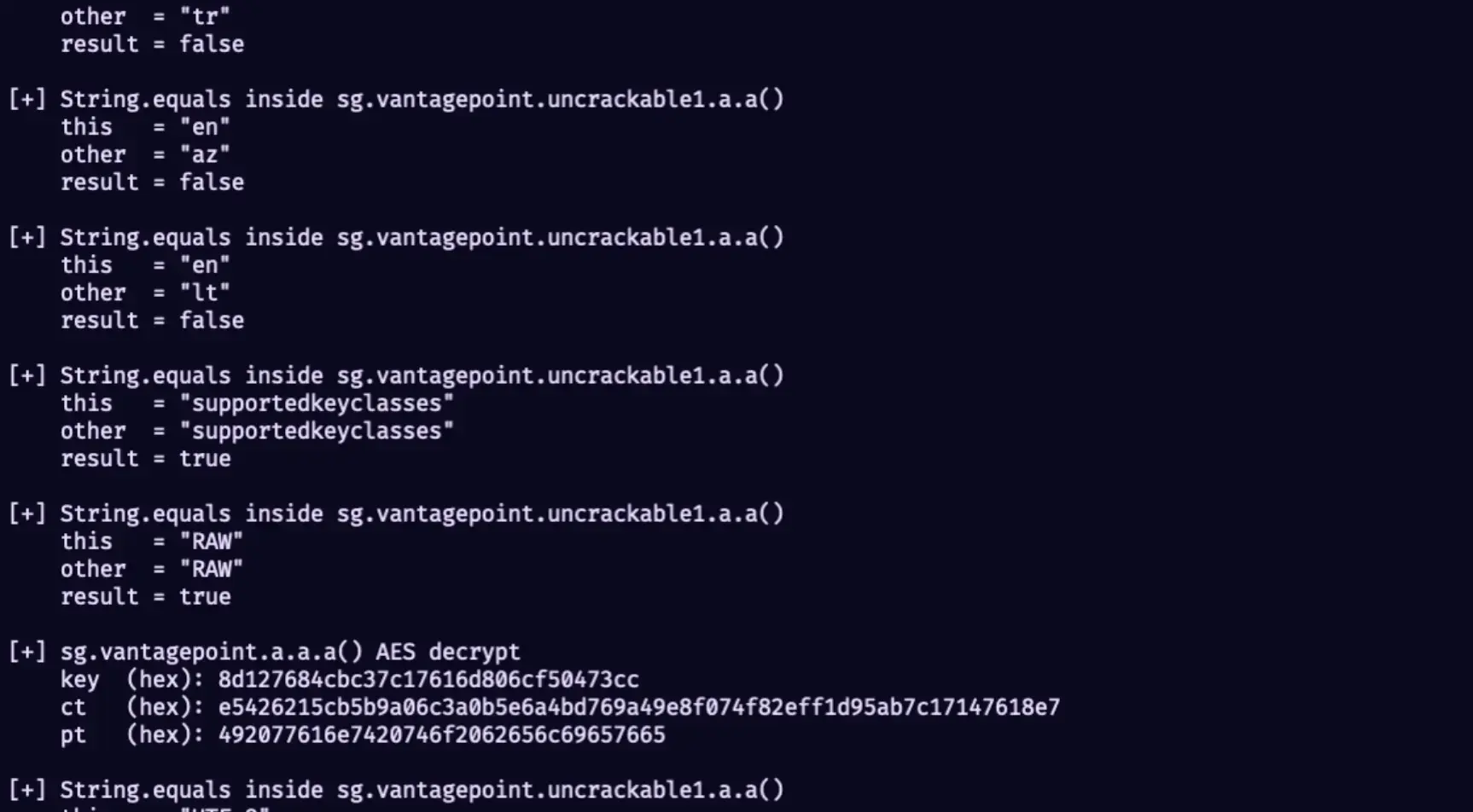
The demo above uses a sample mobile app from OWASP's Crackme, or UnCrackable Apps. In the example app shown, you enter a secret and it is compared to a secret encoded inside the app. This secret is encrypted statically and only decrypted at runtime to compare with the secret entered by the user. With Frida, we can easily find this secret string.
A typical Frida-enabled analysis session can let someone observe app behavior, intercept function calls, and change runtime decisions.The exact impact depends on the app, the device state, and the protections in place, but the risks usually fall into several categories.
1. The app becomes observable at runtime
Frida can help an attacker see which functions are called, what values are passed around, and how the app responds to different conditions. This is especially useful when the attacker wants to understand authentication, fraud checks, encryption, storage, or API traffic.
Even if code is obfuscated, runtime behavior still has to happen. Frida gives attackers a way to watch that behavior as it unfolds.
2. Local security checks can be manipulated
Many mobile apps include checks for rooting, jailbreaking, emulators, debuggers, tampering, or unsafe runtime conditions. These checks are useful, but they are vulnerable if the app makes the final decision locally.
If an attacker can hook the function that reports whether the device is rooted, they may try to force it to return “false.” If the app checks whether it is being debugged, they may try to alter that result. If the app blocks access when it detects a risky environment, they may try to bypass the branch that enforces the block.
This is why local checks should not be the only line of defense.
3. Certificate pinning may be bypassed
Certificate pinning helps a mobile app verify that it is talking to the intended backend. It is a valuable protection against man-in-the-middle interception.
But if certificate validation happens entirely inside app code, an attacker may use Frida to hook the relevant networking or trust-checking logic. The app may then be tricked into accepting traffic interception, allowing the attacker to inspect API requests and responses.
This does not mean certificate pinning is useless. It means pinning should be part of a broader defense, not the whole strategy.
4. Secrets may be exposed in memory
Hardcoded API keys, static tokens, embedded credentials, and other long-lived secrets are risky in mobile apps. Even if they are hidden or obfuscated in the app package, they may appear in memory when the app uses them.
Frida can help attackers observe when sensitive values are created, passed into functions, or sent over the network. This is one reason mobile apps should avoid shipping long-lived secrets and should use runtime delivery, short-lived credentials, and rotation instead.
5. API behavior can be copied
For many businesses, the biggest Frida risk is not only app tampering. It is API abuse.
Once attackers understand how the app communicates with backend services, they may try to reproduce those calls from scripts, bots, modified apps, or cloned clients. If the backend only checks a user token or a static API key, it may not know whether the request came from the genuine app.
In other words, Frida can be a path from mobile reverse engineering to automated API abuse.
Who is Most Vulnerable to Frida-Based Attacks?
Any mobile app can be analyzed with runtime tooling, but some apps are more attractive targets than others. Risk increases when the app protects something valuable, controls access to paid features, or connects to APIs that can be abused at scale.
Apps are especially exposed if they:
- Rely heavily on client-side security decisions.
- Store static secrets, tokens, or API keys in the app.
- Use certificate pinning but have no additional API-side verification.
- Provide access to high-value data or transactions.
- Run in sectors where fraud, scraping, credential abuse, or automation are common.
- Have backend APIs that trust requests based only on user authentication.
- Lack visibility into rooted, jailbroken, emulated, cloned, or instrumented environments.
Industries with higher risk include banking, fintech, healthcare, retail, eCommerce, loyalty, gaming, gambling, travel, ticketing, mobility, and any business with valuable mobile APIs.
How to Protect Mobile Apps Against Frida
Attackers adapt, tooling changes, and local checks can be patched. The goal is to make runtime instrumentation harder, less reliable, and less useful, while ensuring backend systems do not blindly trust compromised clients.
1. Treat Frida as a runtime risk, not just a reverse-engineering tool
Frida operates while the app is running. That means static protections such as code obfuscation are useful but incomplete. Obfuscation can slow analysis, but it does not stop an attacker from observing runtime behavior.
A better model combines static hardening with runtime detection and backend enforcement.
2. Detect instrumentation and unsafe environments
Mobile apps should look for signals associated with instrumentation and tampering, including:
- Frida or similar runtime frameworks.
- Debuggers and method hooking.
- Rooted or jailbroken devices.
- Emulators and virtualized environments.
- App repackaging or cloning.
- Unexpected libraries, modified memory, or suspicious process behavior.
These checks should be layered and adaptive. A single check is easy to target. Multiple signals, collected over time and evaluated outside the app, are harder to defeat.
3. Move trust decisions out of the app
The app should collect security signals, but it should not be the only authority deciding whether it is safe.
If the final decision happens only inside the app, an attacker can try to hook or patch that decision. A stronger design sends app and runtime integrity evidence to a remote service. The backend then accepts, limits, or rejects API requests based on whether the app can prove it is genuine and running in an acceptable environment.
This is the core idea behind app attestation.
4. Protect backend APIs from non-genuine clients
Frida often helps attackers understand the API. Once they understand it, they may not need the original app at all.
Backend APIs should require more than user authentication. They should also require proof that the request came from a genuine app instance. Short-lived attestation tokens, validated at the API, can help distinguish legitimate app traffic from scripts, bots, modified apps, and cloned clients.
5. Remove long-lived secrets from the app
Do not embed long-lived API keys or shared secrets in a mobile app. Anything shipped in the app can eventually be extracted or observed.
Use runtime secret delivery where possible. Secrets should be delivered only after the app passes integrity checks, should be short-lived where practical, and should be rotated without requiring a new app release.
6. Keep certificate pinning, but do not rely on it alone
Certificate pinning is still useful. It raises the cost of traffic interception and protects users in many real-world scenarios.
However, pinning can be attacked when the device or runtime is controlled. Combine pinning with runtime protection, app integrity checks, and API-side verification. Dynamic pinning also helps teams update pins without forcing users to install a new app version.
7. Monitor production threats
Frida protection should not be a one-time development task. Teams need visibility into what is happening in production.
Useful signals include:
- Instrumentation attempts.
- Rooted or jailbroken device activity.
- Emulator traffic.
- App cloning or repackaging.
- Failed attestation events.
- Unusual API patterns from suspicious clients.
- Threat trends by app version, platform, and geography.
Visibility helps teams decide whether to block, step up authentication, limit functionality, rotate secrets, or investigate further.
Frida Risk Checklist for Mobile Teams
Use this checklist to assess your current exposure.
App-side Checklist
- Do you detect Frida and other runtime instrumentation frameworks?
- Do you detect rooting, jailbreaking, debugging, emulators, and app cloning?
- Are checks layered, or do you rely on one obvious detection method?
- Is sensitive logic protected against simple runtime manipulation?
- Is code obfuscation combined with runtime protection?
- Can runtime policies be updated without waiting for a full app release?
API-side Checklist
- Can your backend tell whether a request came from the genuine app?
- Do APIs require short-lived proof of app integrity?
- Are API keys or shared secrets removed from the app package?
- Can credentials and pins be rotated quickly?
- Do you monitor API calls from suspicious clients, bots, or modified apps?
- Can you limit or block API access when app integrity fails?
Business Risk Checklist
- Would attackers gain value by automating your APIs?
- Could runtime tampering unlock paid features or bypass fraud checks?
- Would exposed API traffic reveal sensitive customer or business data?
- Are your mobile APIs protected separately from your web APIs?
- Do security, product, and fraud teams share visibility into mobile threats?
A Practical Layered Defense
A good Frida defense includes:
- Static hardening to slow reverse engineering.
- Runtime detection to identify instrumentation, tampering, and unsafe environments.
- App attestation to verify app authenticity and runtime integrity remotely.
- API enforcement to reject requests that lack valid proof from the genuine app.
- Runtime secrets protection to avoid exposing long-lived credentials.
- Dynamic certificate pinning to strengthen network trust and support fast updates.
- Threat monitoring to understand what attackers are doing in production.
Approov can support many of these layers, including app attestation, runtime secrets protection, dynamic certificate pinning, and API-side token enforcement. But the broader principle applies regardless of vendor: do not place all trust in an app running on a device the attacker may control.
Final Thoughts
Frida is popular because it is useful. It gives researchers a fast, scriptable way to understand running software. That same power makes it attractive to attackers targeting mobile apps and APIs.
The right response is not panic, and it is not a single anti-Frida check. The right response is layered security: make the app harder to inspect, make runtime manipulation easier to detect, move trust decisions to the backend, remove static secrets, and verify that API requests come from genuine app instances.
If your app protects money, identity, health data, paid content, loyalty value, proprietary data, or high-volume APIs, Frida should be part of your mobile threat model.