

Overview
Traditional mobile security has long relied on compliance-driven checklists: Is ProGuard enabled? Are API keys hidden in a .env file? Is root detection implemented? While a checklist provides a baseline, it creates a false sense of security. Mobile applications do not execute in a sandbox controlled by your enterprise; they run on untrusted client devices under hostile conditions.
To protect your backend infrastructure, engineering teams must shift from static checklists to an active Mobile Application Risk Management (MARM) program. A MARM program is a continuous, holistic security architecture designed to evaluate risk dynamically at runtime across the entire mobile ecosystem.
The Paradigm Shift: Why Obfuscation Fails in the Age of AI
For years, code obfuscation was the standard defense-in-depth tactic to shield application logic and embedded keys. However, in the era of AI and advanced automation, relying on obfuscation to protect secrets is fundamentally broken.
The Reality of AI-Driven Reverse Engineering
Advanced AI models and LLM-powered decompilers can now analyze control-flow graphs, recognize cryptographic patterns, and de-obfuscate complex binaries in seconds. What once required a highly skilled human engineer weeks to reverse-engineer can now be automated at scale.
If an API key, an LLM token, or a cryptographic credential lives inside your app binary, it is a static asset in a hostile environment. A determined attacker armed with modern traffic interception tools and AI assistance will find it. Your defense cannot rely on how well you hide a secret; it must rely on removing the secret entirely.
The Core Philosophy: Zero Secrets Architecture
The foundational pillar of a modern MARM program is Zero Secrets Architecture. Instead of attempting to harden the client app package to guard embedded keys, a Zero Secrets model dictates that the mobile application holds zero long-lived credentials that can be extracted, scraped, or abused.
Instead of hardcoding keys, zero secrets architecture improves security using the following features:
Cloud-Managed Secrets
Third-party credentials, such as OpenAI/Anthropic LLM API keys or payment gateway tokens, are migrated to a secure cloud repository.
Deterministic Runtime Attestation
Before any sensitive data or token is released to the app, the client must cryptographically prove its legitimacy to an attestation service.
Just-in-Time (JIT) Delivery
Valid secrets are delivered into the app’s volatile memory only at the exact moment an API call is made, and only if the app and device are proven secure.
Short-Lived Tokens
Communication with your backend is authorized using short-lived tokens. Even if an API request is intercepted, the window of exploitation is limited to minutes, eliminating widespread automated fraud.The Five Dimensions of a MARM Program
A robust MARM program abandons the "app-centric" view and secures the five core surfaces of the mobile threat environment.
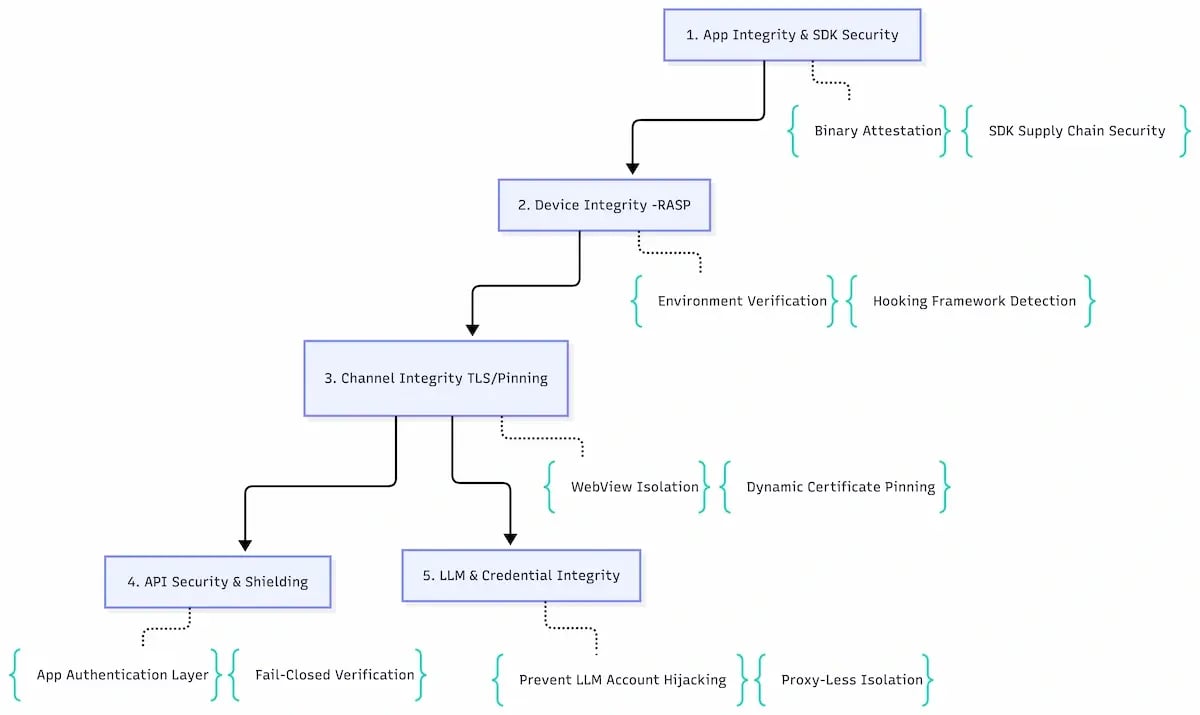
1. App Integrity & SDK Security
Your program must guarantee that the application executing on the user's device is the exact binary you compiled and signed.
- Binary Attestation: Implement runtime application self-protection (RASP) that measures the application's "DNA", verifying that the package name, signature, and executing code have not been tampered with or cloned.
- SDK Supply Chain Security: Third-party SDKs are a major vector for credential harvesting and data leakage. Your MARM program must isolate critical application workflows from non-essential SDKs. Ensure that sensitive API headers and runtime secrets are managed securely via native request-handling layers (e.g., through explicit origin controls) so that malicious or compromised third-party SDKs cannot scrape them from the application memory or web views.
2. Device Integrity
Because you do not own the execution environment, you must dynamically assess the platform health without introducing user friction.
- Environment Verification: Detect if the host OS is rooted or jailbroken, or if it is running within an emulator or a simulator used for automated bot harvesting.
- Hooking Framework Detection: The system must actively look for active dynamic instrumentation frameworks (such as Frida, Magisk, Cydia, or Xposed) that attackers use to hook into runtime memory and bypass client-side logic.
3. Channel Integrity
Data in transit must be shielded against sophisticated Man-in-the-Middle (MitM) attacks, which bypass app-level security by sniffing traffic directly.
- Dynamic Certificate Pinning: Traditional static certificate pinning is brittle. If a certificate expires or rotates, the app breaks until an update is pushed through the App Store. Your MARM program must utilize managed, dynamic certificate pinning that allows certificates and pins to be rotated over-the-air in real time without service interruption.dynamic certificate pinning
- WebView Isolation: For hybrid architectures, ensure that fetch/XHR requests originating from WebViews default to a safe, fail-closed behavior, preventing unverified or intercepted traffic from silently communicating with backend resources.
4. API Security & Shielding
Mobile security is ultimately API security. If an attacker can extract your API structure, they can bypass your mobile app entirely and script direct bot attacks against your endpoints.
- Application Authentication vs. User Authentication: OAuth and MFA authenticate the user, but they do not prove that the request is coming from your genuine mobile app. Scripted bots can easily replay valid user credentials. Your APIs must require a secondary layer of cryptographic proof that verifies the client application itself is authentic.
- Fail-Closed Verification: Configure backend API gateways to strictly validate attestation tokens. If a token is missing, expired, or improperly signed, the backend must instantly drop the request before processing any business logic.
5. LLM and Credential Integrity
With the explosive growth of client-side AI enablement, protecting expensive LLM APIs is paramount.
- Preventing LLM Account Hijacking: If an attacker extracts an LLM API key, they can redirect your inference budgets to power their own models, steal prompt engineering IP, or extract backend datasets.
- Proxy-Less Isolation / Dynamic Header Substitution: Simply putting an unauthenticated backend proxy between your app and the LLM provider does not solve the issue. Attackers will simply abuse your proxy endpoint instead. By pairing runtime attestation with dynamic header substitution, the app requests a token from the proxy, which is substituted in-flight only when the app proves it is authentic, untampered, and running in a clean environment.
Operationalizing MARM: Key Takeaways for Developers
Building a sustainable MARM program requires integrating security into the DevOps pipeline, rather than treating it as an afterthought.
- Design for Ephemerality: Assume the client-side binary is completely transparent. Never store a string, token, or URL that you wouldn't want published openly.
- Decouple Secrets from Code Deployments: Use cloud-side runtime secrets management so that security operations teams can rotate keys, update pins, and respond to threat intelligence instantly without forcing developers to rush out an app store patch.
- Demand Real-Time Visibility: Implement logging and telemetry that alerts your security operations team the moment an app environment flags a Frida hook, a tampered signature, or an expired pin validation.
By executing a programmatic MARM strategy rooted in Zero Secrets Architecture, mobile development teams can safely ship advanced AI capabilities, defend their APIs from automated exploitation, and remain resilient against the evolving, AI-driven threat landscape.