Despite facing significant geopolitical challenges Huawei has navigated a complex global landscape by demonstrating resilience in its mobile division. The company continues to innovate with novel software and hardware development. This article explores the latest market dynamics and the future of its proprietary NEXT operating system with a forward-looking forecast for Huawei mobile devices.
Market Share Dynamics (2021-2025)
China’s smartphone market is dominated by a handful of big brands, with vivo, Huawei, Apple, Xiaomi, OPPO and Honor taking most of the share in recent years.
2025 China Smartphone Share by Brand (Approximate)
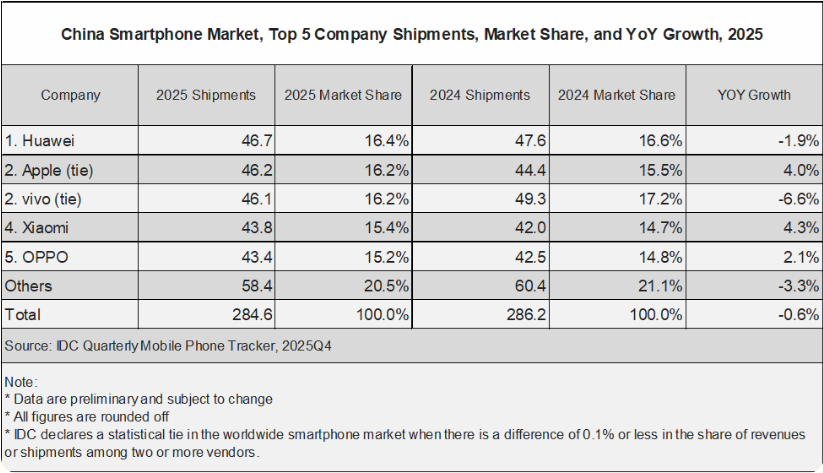
Source: China’s Smartphone Market Rebounds with 5.6% Growth in 2024, Fueled by vivo and Huawei
Market Share Comparison with Apple in Mainland China
Apple has led Huawei globally over the last five years, while in China Huawei fell sharply after sanctions and then caught back up, essentially matching or slightly edging Apple by 2025.
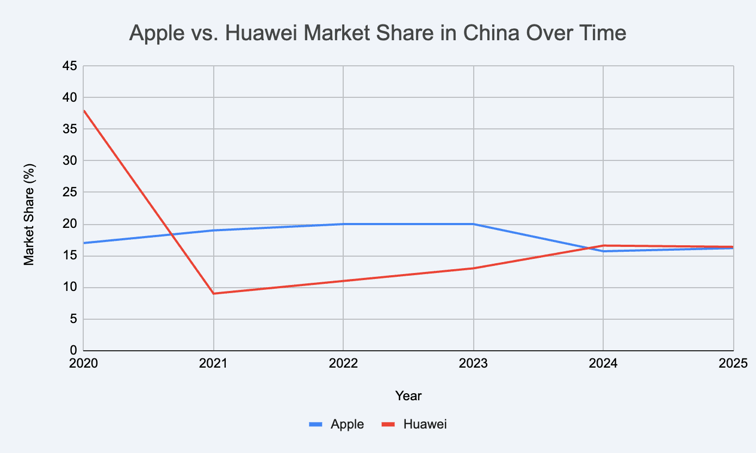
Data Source: CIW, IDC, statista, scmp
Huawei's Evolving Global Market Share
The last five years have seen dramatic shifts in Huawei's mobile market share, primarily due to the impact of US sanctions, which restricted its access to key components and Google Mobile Services (GMS). This has fundamentally altered its geographical distribution of sales.
While comprehensive, recent data detailing market share by country is proprietary and complex to aggregate, the regional trends clearly illustrate the company's shift in focus and success. The following diagram provides an estimated, high-level overview of the global trend, demonstrating the sharp decline outside of its domestic market (Mainland China) followed by a stabilization focused on internal growth.
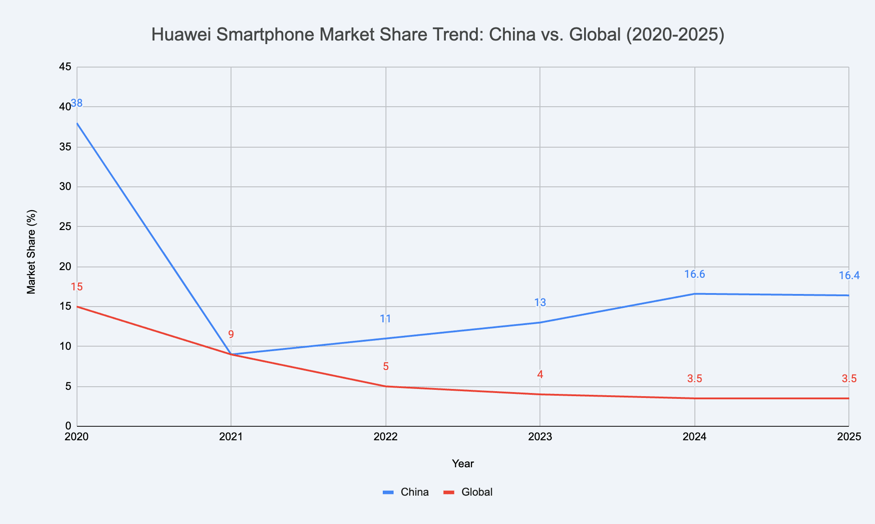
* Values above are rounded and synthesized from IDC, Canalys/statistical reporting, Display Daily, China Daily, Huawei Central and secondary analysis; exact percentages differ slightly by source.
Huawei has successfully leveraged strong national support and advanced hardware innovations to consolidate its position as a leading brand within Mainland China. Outside this region, the market share remains challenged but persistent, primarily serving niche markets or consumers less reliant on GMS.
Why China’s Market is Different
-
Strong domestic ecosystem
- Huawei HarmonyOS
- Vendor app stores
- China-specific services
-
Government policy
- Local tech prioritization
- Subsidies for domestic devices
-
Ecosystem lock-in
- WeChat super-app dominance
- OEM app stores instead of Google Play
HarmonyOS NEXT: An Independent Ecosystem
The most significant development for Huawei's mobile future is HarmonyOS NEXT, a version of its operating system that marks a complete and decisive break from its Android roots.
Key News and Features of HarmonyOS NEXT
HarmonyOS NEXT is not a rebranded or modified version of Android; it is a native, independent ecosystem, the culmination of Huawei's post sanctions survival strategy.
- Removal of AOSP Code: The "NEXT" iteration removes all remaining components of the Android Open Source Project (AOSP), meaning it can no longer natively run Android apps.
- Pure Native Ecosystem: The focus is on a fully native application experience built with the HarmonyOS application framework. This is expected to significantly improve performance, security, and integration across Huawei's diverse range of devices (smartphones, tablets, smartwatches, and IoT devices).
- Developer Focus: Huawei has been aggressively courting developers to build native HarmonyOS apps, with targets for thousands of critical and widely used applications to be available natively by late 2024.
The initial group of major native applications for HarmonyOS NEXT, which are scheduled for release via the HUAWEI AppGallery by September 2024, has been publicized on Wikipedia. These applications include, but are not limited to, Alipay, Taobao, JD.com, Meituan, Douyin (TikTok China), Xiaohongshu, QQ Music, iQIYI, and WPS Office.
WeChat (Weixin) officially announced its HarmonyOS NEXT phone release in January 2025, after having conducted internal beta testing in October 2024.
- Microkernel Architecture: HarmonyOS is based on a microkernel design, which is intended to offer superior security and resource management compared to traditional monolithic kernels.
Compatibility Issues: The Android App Challenge
HarmonyOS Next was commercially launched on October 22, 2024, as part of the HarmonyOS 5 line branded “HarmonyOS NEXT 5.” With the transition to HarmonyOS Next, the previously existing compatibility layer that allowed HarmonyOS devices to run standard Android apps is being removed.
Compatibility Transition
|
Operating System Version |
Android Compatibility |
Current Status |
|---|---|---|
|
Older Huawei Devices (EMUI) |
Full GMS/AOSP compatibility |
Legacy, Phase-out |
|
HarmonyOS 2.0 / 3.0 |
AOSP compatibility (non-GMS) |
Transitional, Still in use |
|
HarmonyOS Next |
NO native Android compatibility |
Future Standard |
The new HarmonyOS NEXT system initially faced market criticism regarding application compatibility. Since NEXT does not include an Android runtime, the "workaround" for Android apps is through non-official Android containers published on AppGallery, rather than an official Huawei layer.
This temporary solution emerged in December 2024 when beta testers found an Android emulator called "EzsyAbroad" (EasyAbroad) in the AppGallery. This tool allows HarmonyOS NEXT users to download and run Android applications within a dedicated container, effectively bridging the app gap despite the core OS being free of Android code. However, this "workaround" suggests that a permanent, complete resolution to compatibility is not yet available and was likely introduced in response to market pressure.
The move to HarmonyOS NEXT which represents the Future Standard operating system, means older Android apps will not be natively compatible. This presents a substantial challenge in international markets where users rely heavily on the Android app store and ecosystem. The updates on this issue are clear: Huawei is not attempting to maintain backward compatibility. Instead, it is forcing the hand of app developers to create native HarmonyOS versions, believing that its domestic market size and technological superiority will provide the necessary incentive. The company's official forecast anticipates that a critical mass of native apps will be achieved during the 2026-2028 period, leading to HarmonyOS being recognized as a third major mobile OS.
Here are several anchor points for the number of native HarmonyOS NEXT apps on AppGallery:
|
Date (approx) |
Native HarmonyOS NEXT apps on AppGallery (apps + meta services) |
|
Jun 2023 (beta) |
1,500 |
|
Sep 2024 |
10,000+ |
|
Jan 2025 |
20,000+ |
|
Nov 2025 |
300,000+ |
|
Jan 2026 |
350,000+ |
Source: wikipedia, harmony-developers
New Trends and 3-Year Forecast
Huawei's strategy for the coming three years is characterized by innovation, self-reliance, and ecosystem integration.
New Trends in Huawei Devices
- 5G Chipset Self-Sufficiency: Recent advancements indicate Huawei's ability to produce highly competitive 5G chipsets domestically, bypassing previous supply chain constraints and enabling new device launches like the Mate 60 series.
- Satellite Communication: Integration of advanced satellite communication capabilities (like two-way satellite messaging) is becoming a standard feature in their flagship devices, positioning them at the forefront of mobile communication technology.
- Cross-Device Integration: A deep commitment to the "1+8+N" strategy, where the smartphone is the center, surrounded by 8 other Huawei product categories (laptops, watches, etc.), all seamlessly linked by HarmonyOS.
Forecast for the Next 3 Years (2026-2028)
|
Area |
Forecast for 2026-2028 |
Implication |
|---|---|---|
|
Domestic Market |
Strong growth and consolidation; likely to regain the top domestic vendor position. |
Huawei's foundation and primary revenue source will remain Mainland China. |
|
Global Market |
Stable but niche market share outside of China, focused on enterprise and specialized hardware. |
Recovery in global smartphone volume is unlikely without a major shift in the geopolitical landscape. |
|
Critical mass of native apps achieved; recognized as a third major mobile OS (alongside iOS and Android). |
Success hinges entirely on developer adoption and user experience quality. |
|
|
Hardware Innovation |
Continued leadership in camera technology and advanced power efficiency from proprietary silicon. |
Huawei will use hardware performance as a key differentiator. |
A great smartphone experience requires a secure ecosystem. Fast devices and polished UIs feel risky if users fear data theft. A robust ecosystem ensures apps, APIs, cloud services, and payments work together reliably and safely. A weak ecosystem leads to account takeovers, fake apps, broken logins, or blocked services, eroding platform trust.
Because much risk is external, relying solely on the OS vendor is insufficient. An independent security solution adds a separate, owned control layer. It verifies app authenticity, protects APIs, and shields data even if the OS or network is compromised. This independence ensures:
- Consistent protection across Android, iOS, HarmonyOS, and future platforms.
- Defense in depth, maintaining security even with platform bugs or policy changes.
- Compliance and accountability, providing auditable controls beyond just relying on the OS.
Ultimately, a superior user experience is built on the confidence that strong, independent security protects their information, regardless of device or OS.